



 MENU
MENU
The Difference Between a Lateral Rotation Mattress and an Alternating Pressure Mattress
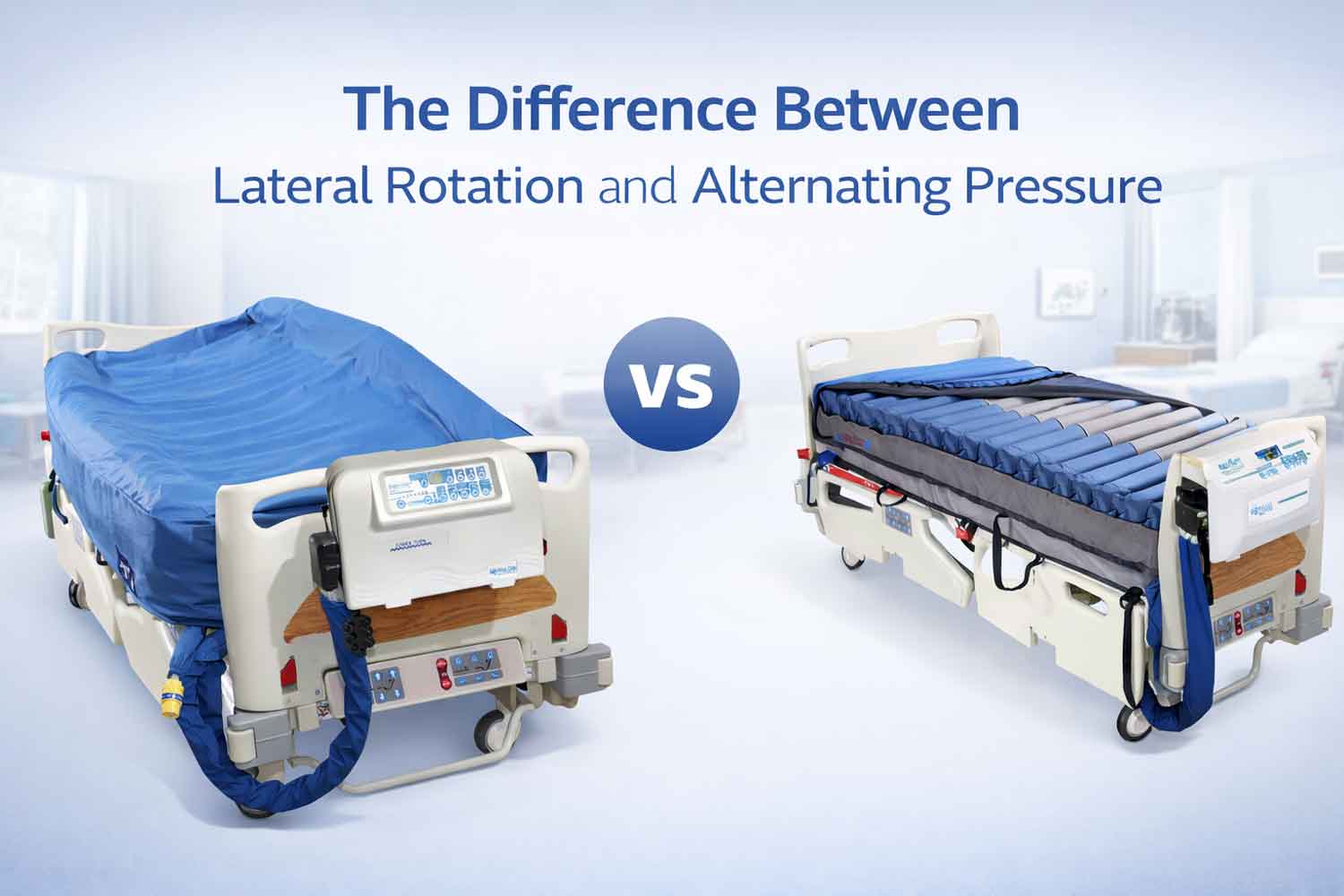
Clinical Summary
A lateral rotation mattress provides automated side-to-side turning (typically 25–40°) primarily to assist patients with respiratory compromise and pressure redistribution while in a flat position.
An alternating pressure mattress redistributes pressure by cyclic inflation and deflation of air cells and can be used in both flat and elevated (Fowler) positions.The appropriate therapy depends on respiratory status, wound location, mobility level, and bed positioning requirements.
What are the differences between therapies for the prevention and treatment of Pressure Sore Injuries?
Within wound care there are misconceptions between the therapies and when each is appropriate. One of the most common misconceptions is that Lateral Rotation is more advanced than alternating pressure at wound treatment. This is especially true when a patient is not responding to alternating pressure. To help understand the differences between mattress systems, below is an explanation of each and factors to consider when choosing a wound healing mattress for a patient.
Lateral Rotation Mattress vs Alternating Pressure Mattress
Both mattresses redistribute pressure for the prevention and treatment of Stages I – IV Pressure injuries (also historically referred to as pressure sores or decubitus ulcers). Lateral Rotation therapy rotates the patient to achieve pressure redistribution while in Alternating Pressure, the mattress bladders alternate underneath the patient. However, the primary therapeutic benefit differs.
Lateral Rotation vs Alternating Pressure — Clinical Comparison
| Feature | Lateral Rotation Mattress | Alternating Pressure Mattress |
|---|---|---|
| Primary Mechanism | Side-to-side rotation (25–40°) | Cyclic inflation/deflation of air cells |
| Best For | Respiratory compromise with wounds | Pressure injury prevention & treatment |
| Bed Position | Primarily flat | Flat or Fowler (up to 65°) |
| Risk Consideration | Shear & Fall risk when turned | Shear risk mitigated in advanced systems |
| Hip Wounds | May increase pressure if on rotation side | No side loading |
| Reactive Hyperemia | Minimal | Yes |
| Low Air Loss | Yes | Yes |
LATERAL ROTATION
The primary focus of lateral rotation is pulmonary therapy. Pressure redistribution for pressure injury treatment is a secondary benefit.
This is achieved by turning the patient side to side up to 40 degrees. The movement redistributes pressure to help prevent and treat stages I-IV pressure ulcers. However, a Lateral Rotation mattress is primarily utilized when specific pulmonary conditions exist. One of the most important considerations is the presence of significant respiratory issues such as Pneumonia and other pulmonary complications. If the conditions outlined below do not exist, an Alternating Pressure Mattress with Low Air Loss may be more appropriate. Additionally, if a patient has skin breakdown on the hips, one must be careful to take that into consideration.
What to consider when considering the use of a lateral rotation mattress system?
Deciding if a Lateral Rotation Mattress system is a more appropriate choice than an Alternating Pressure Mattress? Please consider the following factors:
- Does the Patient predominately lay flat?
- Does the Patient have or is highly prone to developing significant respiratory issues such as Pneumonia?
- The patient requires skin protection but does not have late stage skin breakdown on the hips
- The patient does not transfer independently
If the answer is YES to questions 1- 4, a Lateral Rotation Mattress System may an excellent therapy to prevent and treat pressure injuries. If the answer is NO, keep reading.
Lateral Rotation Mattresses are meant to be utilized in the predominately flat position.
If the head of the patient’s bed is raised, the use of a lateral rotation mattress may increase fall risk. One may be able to incline these mattress systems slightly however, the fall risk increases with each degree of incline. This is especially true when someone does not possess the core strength needed to keep themselves seated up-right. It is recommended to use rails to prevent any accidental falls. Lateral rotation mattress systems are designed to be used in the predominantly flat position! This precludes patients who raise the head of the bed or who must have their heads elevated.
Lateral Rotation Mattresses helps to move fluid in the lungs.
A Lateral rotation mattress rotates side to side in a timed sequence to help prevent pressure injuries. However, that same side to side movement helps move fluid in the lungs to reduce respiratory issues. If someone has both significant respiratory and skin breakdown concerns, a lateral rotation low air loss mattress system may be a more appropriate choice.
Lateral Rotation can put additional pressure on the hips.
If a patient presents with late stage or unstageable pressure sore injuries on the hips, turning the patient to the side with the injury can put additional pressure on the injury. To help alleviate this, the mattress can be set to only turn in the opposite direction of the injury, limiting therapy. The location of pressure injuries should be a consideration.
Note: Many lateral rotation mattress systems only rotate the patient up to 25 degrees. Choose a lateral rotation mattress system that can rotate from 30 up to 40 degrees. Blue Chip Medical’s Power Pro Elite™ is an excellent example of a true lateral rotation mattress system.
https://www.bluechipmedical.com/alternating-pressure-mattress-2/power-turn-air-mattress/
ALTERNATING PRESSURE MATTRESS SYSTEM
The primary focus of Alternating Pressure therapy is pressure redistribution for the prevention and treatment of pressure injuries.
An Alternating Pressure Mattress is constructed of a series of horizontal air bladders that cover the full width of the mattress whose internal pressures “alternate” in timed sequenced cycles. The internal air pressures of the bladders are controlled by an alternating pressure pump and set according to patient weight and comfort.
For simplicity, a Blue Chip Medical alternating pressure mattress has 18 air bladders. There are two sets of air bladders in a series. There is an odd series (bladders 1,3,5,7,9, etc) and an even series (2,4,6,8, 10, etc). While the odd series bladders are inflated and firm, the even series bladders are deflated and soft. In timed sequenced cycles the soft bladders inflate to become firm as the firm bladders become soft. Within that exchange from soft to firm, all bladders hold at the same pressure for one minute. This continually redistributes the pressure between the body and the mattress, to help prevent and treat pressure sores and diabetic wounds. Additionally, Alternating Pressure improves blood flow through a process called Reactive hyperemia (temporary increase in localized blood flow following pressure relief).
Alternating Pressure can be utilized in the flat or inclined position.
Alternating Pressure therapy can be utilized for a patient in the prone or Fowler positions up to 65º. Some advanced mattress systems such as Blue Chip’s Adapt Pro Elite™ provide an automatic Fowler adjustment to prevent sinking into the mattress and skin shearing injuries.
https://www.bluechipmedical.com/alternating-pressure-mattress-2/adapt-pro-elite/
Alternating Pressure with Low Air Loss should be considered for the prevention and treatment of stages I-IV pressure sore injuries when the following exists.
- The patient is receiving therapy when the head of the bed is inclined.
- The patient is tube fed
- The patient does NOT have or is prone to significant respiratory issues such as Pneumonia.
- The patient requires prevention and treatment of stages I-IV pressure injuries.
- The patient transfers independently (mattress should be placed in the static mode while transferring)
- COPD and can be raised a minimum of 30 degrees or more
It is important to assess the patient and take all the factors above into consideration when selecting the appropriate therapeutic mattress for wound care and prevention. Both Lateral Rotation with Low Air Loss and Alternating Pressure with Low Air Loss mattress systems are excellent therapies at preventing and treating pressure injuries, when matched properly to the patient’s needs.
IMPORTANT NOTE:
The above are general statements, there are some exceptions. The above is not meant to diagnose or treat any medical condition.
Always seek the advice of a wound care professional.

Authored by: Jeff Adise
Jeff has dedicated over 30 years to advancing wound care solutions. He is a product specialist and developer of therapeutic support surfaces for the prevention and treatment of Stage I–IV pressure injuries in hospital beds, home recliners, lift chairs, wheelchairs, and more.
New Products



Continuing Education Program

For Clinical or Technical Assistance
CALL 800 795-6115
For technical assistance or help choosing the correct product for your specific application.

Recent Blog
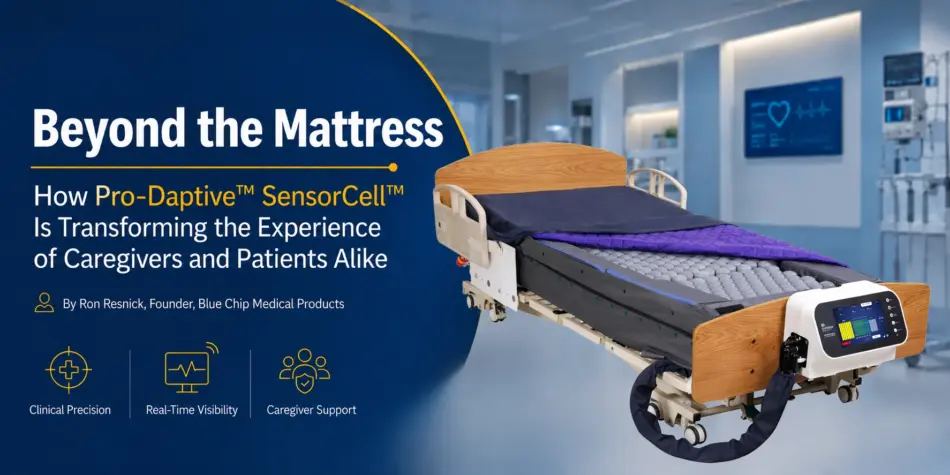
Beyond the Mattress: How Pro-Daptive™ SensorCell™ Is Transforming the Experience of Caregivers and Patients Alike
The ProDaptive SensorCell mattress provides ultimate pain relief for seniors, while making repositioning safer and easier for family caregivers.

The Hidden Cost of Pressure Injuries, and How ProDaptive™ SensorCell™ Is Changing the Financial Equation
The Prodaptive SensorCell mattress helps seniors stay independent and pain-free at home, while avoiding costly hospital stays.

Supporting K9 Heroes With Custom Transport Pads Built for Safety and Fit
Blue Chip Medical donates custom, medical-grade transport pads to keep service dogs comfortable, safe, and supported on duty.